Showing posts with label Hong Kong. Show all posts

Sunday, December 5, 2010

Pink Dolphins at Tai O

I decided that it was time for Richard to visit Tai O to see the village on stilts and hopefully catch a glimpse of Pink Dolphins. I had been to Tai O some months ago with my year 6 class. It is a great time of the year for a visit as the weather was perfect, warm but not hot with big clear blue skies.


Tai O is better known as the Venice of Hong Kong as it is a rare example of a Chinese stilt – house community situated on the far northwestern coast edge of Lantau Island. It is home to the Tanka people, a community of fisher folk who have built their homes on stilts above the tidal flats for generations because they do not feel safe on land. It took us a couple of hours to get there; bus to central, then the ferry to Mui Wo and finally a bus to Tai O, but it was well worth it.


We began by strolling through the markets filled with stalls selling pungent shrimp paste, dried fish and handicrafts. Fish of all sizes from shark to squid hang drying wherever you seem to look and there are baskets of what looks like lime peel soaking up the sun as well. What they do with this I am not sure, but at the moment it seems like a popular thing to dry.


We had a look through an exhibition of local antiquities organized by the Tai O Rural Committee which has a good collection of relics, photographs and other memorabilia of a time when Tai O was a thriving port. Over the fairly recently built bridge that has replaced the rope drawn sampan that ferried people across to the other side, we wandered over the canal and glimpsed our first stilt houses. More markets filled the streets, offering free samples of food to draw in the hungry hordes. We headed to a restaurant for lunch of delicious salt and pepper squid (my favourite) and rice.

After lunch we decided to leave the busy market place and head further along the lanes to see what life was like living there. We passed the Kwan Tai Temple and numerous small shrines and then hit the canal.


We discovered a whole host of other restaurants including a funky cafĂ© on the edge of the town’s main canal. It turned out to be a great place to sit and absorb activity on the canal including birds fishing for their dinner. The owner brought out books of the history of Tai O , full of great photos for us to browse through so that we got a better sense of what the place would once have been like.


Once our lunch and coffee had settled, we decided to go on a 25 minute boat ride up the canal to get a look at the stilt houses from the water, and then we headed out to sea to do a bit of dolphin spotting.


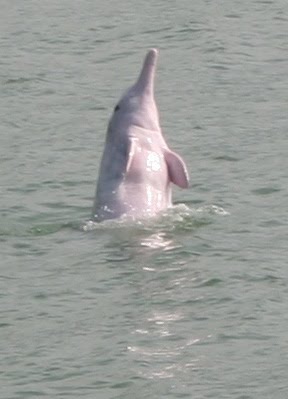
Chinese White Dolphins, often called pink dolphins, can be seen frolicking off the coast close to Tai O and a marine park north of Tai O has been developed to help protect them. When I went with my class we spent over an hour out watching them and saw loads and loads, swimming in family groups, breaching the water, generally having a great time playing. On Friday we were only out in the ocean for a very short time, but in that time did manage to see a couple of dolphins having a good old frolicking. Well worth the HK$20 that we paid. The photos below are from the first trip we did, as I knew I already had some good photos so did not bother taking any more, just enjoyed the view.




All too soon it was time to head home. On the way out we briefly visited the Tai O Culture Workshop which was opened by a local woman in the ground floor of her family home and contains loads of implements used by generations of fisherfolk. We decided to catch a bus to Tung Chung and then the MTR to Central and a bus home. Tai O turned out to be a fabulous place to explore and we decided that it would be worth coming back again, next time for an overnight stay as we found a great looking little B&B in fact we have booked a stay there for my birthday.

Seeking Spirituality in Mid Levels


Hong Kong Island is dominated by a steep hilly terrain with the majority of the population living in towers around the edge of the island. The area known as Mid-Levels is situated on the slopes above Central overlooking Victoria Harbour however because of all the development and the hundreds of towers, it is now impossible to glimpse the harbour from street level. To help with the movement of loads of people the government cleverly decided in 1993 to build an escalator system that would effectively link the Central and Western Districts and decrease traffic problems. There are a total of 20 outdoor escalators and three moving sidewalks making it over 800 metres with a vertical climb of 135 metres and if you were to go from the bottom to the top standing on the escalators rather than walking along them, the travel time would be approximately 20 minutes. Apparently it is considered to be the longest outdoor covered escalator system in the world and supposedly moves around 55 000 people per day! The escalator runs down the hill between 6am and 10am to get people to work in Central and then it is turned off and the direction changed to going uphill from 10.30 am until midnight when it stops. I had always thought of Mid-Levels as literally the area surrounding the escalators with restaurants, bars, and shops lining its route and therefore common place to find expats out for a good time, thus associated with excessive drinking and partying, so not really my ideal haunt and therefore up until now little explored by me except for the odd dinner out. But I was to discover that it is so much more than this.


I had purchased a book called the leisurely Hikers Guide to Hong Kong, I liked the word leisurely in the heading. This book contains lots of different walks, both out in the natural areas of Hong Kong and in the centre of all the hustle and bustle of city life. The walk we decided to do this Saturday was called a Spiritual Hike… being centred around Mid Levels I am sure Richard thought that Spiritual referred to a different type of spirits…and took in a couple of small shrines and the Man Mo Temple (Literary and Military temple) dedicated to two separate gods who represent culture and soldiery respectively. We left the escalator system at Stauton Street where the SoHo fair was almost in full swing. Loads of restaurants line this street alongside funky vintage boutiques and antique stores. Here is what is now called SoHo.

The pungent smell of incense grows thicker the closer we get to Peel Street where there is a small but well patronized shrine on the corner.


Soon after this the crowds began to peter out and we found ourselves wandering along small lanes where there are no cars and you could actually hear the call of birds. Wing Lee Street contains a line of traditional Hong Kong tenements which have survived from another era. Most of them still have the antique printing presses operating from the ground floor as this area was originally dedicated to printing. After walking through a small park and soaking up the sunshine and quietness of the old area, we headed down an area of old stone stairways, a good indication of what the Mid-Levels were like before the advent of the motor car. The district that we were in was formerly known as Tai Ping Shan, once a hotbed of crime, disease and prostitution. After an outbreak of the plague sometime in the 19th Century they razed the whole area allowing for the development of multi story tenements to then be razed to allow the development of the towers that now dominate the island.


Once we reached Hollywood road (referring to the Irish estate of a former governor rather than links to Tinsel town) we found the Man Mo Temple. We were aware of its existence well before finding it for the smell of incense was almost over powering. Many Temples and Shrines in Hong Kong are dominated not just by individual sticks of incense but by huge coiled incense hanging from the ceiling. I am beginning to think the haze that often lies over Hong Kong is not caused by industry in China but by the incense being burnt in the thousands of shrines and temples throughout Hong Kong.

We were unable to spend more than a minute of two in the temple before my lungs decided they would no longer work, so we head down Hollywood Street to check out all the antique shops. We found a fantastic little street off Hollywood road containing a collection of antique shops, second hand stores and loads of bric-a-brac stalls, much more interesting that the other markets that we have frequented. Apparently once upon a time, this was the place to go and buy back whatever you had had stolen from you in the morning. Not something that would happen now, as the crime rate is so, so low. I am beginning to understand why it is so low, as the laws are pretty strict. I saw a poster the other day that said that the penalty for shoplifting is 10years imprisonment… that is some deterrent!


Finally we emerged from Mid Levels into the Western District at the Western Market. This Edwardian building has been renovated and now houses small shops including a lot of fabric shops. There was also a Chinese desert house here where I decided it was a must to enjoy a cup of tea and a Chinese sweet. Unfortunately I could not tempt Richard to partake in anything but the tea as he is definitely not a fan of the glutinous rice sweets that they eat here, something that I learnt to love in my time living in Japan.

Time to end the trip with a tram ride back to the bus station. We managed to procure a seat up the top of one of the many double decker trams that ply the streets of this part of the Island. As the trams have no air-conditioning, they have open windows and as it was not hot, it was a perfect place to sit and watch the city go by as the tram slowly made its way to its destination.

We decided that we would not get off at the Central bus station but continue on the tram as far as Causeway Bay which was probably not the best decision in hindsight as Causeway bay is very busy with people at the best of time, let alone a month before Christmas when the department store Sogo was having a sale. You could hardly move through the sea of people, but with a bit of subtle maneuvering we did make it to our bus stop and headed for home.


Thursday, December 17, 2009

A Deliciously Decadent Day


Bridget arranged a lovely birthday treat for me. We met at the Wanchai Pier and caught the ferry across the harbour to Kowloon. Our first stop was for a spot of Christmas shopping at the Chinese Arts and Crafts centre. A couple of hours later, laden with packages we headed to the Peninsula Hotel where we were to have high tea. Nothing is more evocative of the olden days of Hong Kong than Afternoon Tea beneath the neo classical arches of the Peninsula Lobby, a living example of history that takes you back to a more gracious world when there was always time for tea. The Hotel was opened in 1928 and at that time was known as 'the finest hotel east of Suez'. Passengers arriving in Hong Kong by ocean liner disembarked onto the quays of Kowloon plus, it was the last stop on the trans Siberian rail link that brought travelers from Europe. As such, the Peninsula hotel was ideally situated to take advantage of the increasing number of wealthy visitors to the area.

Today it is still a very prestigious hotel in line with the likes of Raffles in Singapore. The wings at the front of the hotel are home to Tiffanies and Prada, and within the hotel the best luxury brands converge under one roof to satisfy even the most avid shopper, including haute couture, jewellery and fine tailoring. Here you will find Chanel, Dior, Hermes, Gucci, Louis Vuitton and Cartier... need I go on, though obviously a little out of my price range. Beautifully uniformed men in white gloves hold open the door to entice you into the opulent foyer. There is a huge Christmas tree as you enter the lobby, surrounded by tables in what has become the legendary meeting place for the rich and famous, where those who want to be seen sit and dine with a string quartet for musical company.


We queue a few minutes for a table and then prepared to indulge ourselves. Obviously tea arrives in silver teapots and is poured into fine bone china, I chose Jasmine tea. The knives and forks are of antique silver, the serviettes, obviously made of fine linen. High Tea arrives on a triple tiered silver platter, laden with scones, delicate crustless sandwiches including of course the typical cuecumber sandwich eaten by the British, and delicious sweet goodies. Here we spend a couple of hours nibbling, sipping unlimited cups of tea and watching the way the other half live. Everyone who walks by seems to be toting a carry bag from one of the high end boutiques, no one seems to be carrying the China Arts and Craft bags that we have!! After copious cups of tea I am all awash with fluid and desperately need the facilities. I am escorted to the toilet by a beautifully dressed young lady and even the toilet is extravagant. We end our tea by being given a wishing bauble, a Christmas bauble on which we were to write our Christmas wishes and then hang it on the Christmas tree.

Monday, November 30, 2009

A weekend of indulgences


Wow this weekend felt like a non stop round of eating. We started the weekend with a trip to the Gold Coast, no not in Australia, but the newly developed Gold Coast of Hong Kong. I had noticed in the papers that they were having a music Festival in their Piazza and this weekend it was all about Jazz. It has been a while since we have heard any live jazz, so after studying public transport routes, we set off for to Gold Coast which is situated in the New Territories. From the size of some of the boats in their marina, one can assume there is money around. The weather was just starting to warm up again, however in the shadows of the Piazza it was still pretty chilly. We spent the afternoon snacking on German food (not sure what it was about German food, but there seemed to be a lot of it around... I can only assume that there is a community of Germans living in the area.) drinking hot coffee and tapping our toes to the dulcet tones of local Jazz bands as well as guests from around Asia.


In the evening we joined another couple to discover a great little Indian Restaurant just across the harbour from us at Aberdeen. The ambiance of the restaurant was nothing to write home about but the food was great. What a fabulous discovery for us. The weekend was topped off by brunch on Sunday, this time we met up with a colleague of Richards from his time at MCKillop College in Bathurst, Australia. We decided it was time to check out the Jumbo Floating Restaurant. To get to it you need to catch a Sampan across Aberdeen Harbour. The floating restaurant was not as we had expected, once on board it looked nothing like a boat at all, it really was a huge complex with slate floors, massive staircase, shining banisters and a number of different restaurants. We were on the top deck at the seafood and champagne buffet, food was great with plenty of it, and the company and views made it a great lunch. As you can imagine we waddled home, lucky not to have sunk the sampan with all the food we have eaten over the weekend.


An Enlightening Adventure - The Big Buddha


Perched 500m up in the western hills of Lantau is the Nong Ping Plateau where you can find the Po Lin Monastery complex and one of the world's largest statues of Buddha. To get there we decided to take the cable car, however this cable car was unlike any that I had taken before as not only were the sides all glass allowing a spectacular 360 degrees view of the rural landscapes and the airport, but the floor was also glass!! Not for the faint hearted. The whole trip up took about 25 minutes and took us over what looked like a fairly new and interesting hikers trail which we decided we would walk back by. We looked back at the airport, completely developed on reclaimed land, the only flat area of the whole island. Then suddenly the Big Buddha was seen from a distance, its hazy form surrounded by clouds, presiding over yet unseen places.


We had had coffee and a snack in Tung Chung before getting on the cable car as Bridget was not sure that there would be anything at the Monastery. We needn't have worried as at the top there was a whole new village complex dedicated to providing food and shopping pleasures for the hordes of tourists. There was even a Starbucks with a view of the Big Buddha... a bit sad. We arrived during the week when it was a little quieter and during a kite flying event. Huge kites soared above the monastery dancing around the Buddha.


The Po Lin Monastery complex was founded by three monks in 1905, This "Precious Lotus" monastery occupied an isolated setting ideally suited for meditative retreat in the centre of Lantau Island. For many years there was no way to get there except on foot which limited the visitors. It remained largely undisturbed until 1993 when 10,000 spectators showed up for the inauguration of the now famous Big Buddha. The bronze statue represents a bond between the old and the new, it was constructed in Nanjing by China Aeronautics, a company involved in China's space programme. Although cast in sections, it proved too heavy for any helicopter to carry to the lofty site. The alternative meant closing off, for three nights, all roads leading to the monastery, to allow the dismantling of all lamp posts, telegraph poles and electric pylons that might obstruct the oversized trucks transporting the huge precious cargo. The Buddha is seated on a lotus and is around 26.4m high and weighs about 202 tonnes. We climbed up the steps to the base of the Buddha for a closer look and to marvel at the spectacular 360 degree view from the top. We chose a perfect day to visit as the clarity of the air was the best I have seen since arriving here. The wind is obviously blowing from the right direction, and it is blowing pretty strongly. Heavy clouds swirl around the Buddha, touching lightly as though looking for enlightenment then swiftly moving on, never really threatening to set in or give us a drenching.


Huge incense sticks filled the air with a sweet scent beckoning us across to the actual monastery. Despite the number of visitors it is still possible to feel strangely at peace surrounded by golden effigies, red lanterns hanging from the heavily painted ceilings and the colour red everywhere. On leaving the monastery we then walked for a short distance along the enlightenment walking trail. We were looking for a path that we had seen following the contours of the mountain behind the monastery. After a steep climb we seemed to meet a dead end, a shrine where workmen were doing some work. They spoke no English but with sign language and some Cantonese, we managed to get across to them that we were looking for the path to Tung Chung. They sent us back down the mountain which we were not happy about. Just below the shrine to we looked up and clearly saw the path only a couple of metres above the shrine. There had to be a way of getting there. We then saw the builders coming down the trail with rubble, laughing and then pointing at us, obviously amused by two foreigners wanting to walk to Tung Chung. We point to the trail to get the message across that we want to get onto that trail. After a heated discussion amongst the 3 of them, they eventually agree that there is a way to get to the path we want by going around the shrine and beckon us to follow. Once there they try to send us in one direction to Tung Chung saying it will take us 2 hours to get there but we have decided we want to go the other direction as this is the path that we saw from the cable car. So off we set.


The large bell in the Buddha tolls 108 times during the day to symbolise escape from what Buddhists terms the 108 troubles of mankind. As we climbed up along the the path the bells echoed around the valley and the chants of the monks carried on the wind gave us the energy to continue on up the slope. We were convinced we were on the right path as we were now below the cable car. Water rushed down a steep valley below us, the Aquarius in Bridget drew her to the water, but we had no time to rest as the afternoon was drawing to an end. At one particular steep part of the trail we saw another path that took us around the rise, obviously a contour walk was going to be easier so we headed off on this path, assuming it would re-cross the other path at some time. We were so busy chatting away and admiring the view that we failed to notice that we were moving further away from the main path. Eventually we discovered that we were heading in the wrong direction but could see Tung Chung in the distance so we figured that if we continued on this contour it too would drop down the valley to Tung Chung. It turned into a lovely walk winding through low rain forest however passed valley after valley without dropping down, until Tung Chung was but a memory on the other side of the mountain. By this time it was too late to turn back, so we just kept going, it had to eventually drop down a valley as there was no where else for it to go. Suddenly in front of us stood a grove of huge planks of wood that marked part of the Po Lin Monastery enlightenment path... we had completely circumnavigated the mountain and were now a matter of metres from where we started!! It was 5pm and we were still 2 hours from Tung Chung with inevitable darkness a mere hour away. I have to say that for a while panic set in, however we then discovered a wide concrete path with signs to Tung Chung. Even if it were to get dark before our descent, we would be able to walk this path in darkness.


Looking ahead we could see Tung Chung creeping ever closer to this lush valley... we were on the home stretch. It turned out to be a very pretty walk through the Tei Tong Tsai area, a collection of quiet monasteries and pagodas dating back many years, many hidden amongst some of Hong Kong's largest standing bamboo groves. Methodical drumbeats and resonant tones of Buddhist recitals emanated from a tower hidden among the trees, chanting monks could be heard but not seen... all drawing us further onward. As we passed through one monastery a Buddhist nun in a grey cloak with cell phone attached to her ear headed to the vegetable patch to pick food for dinner. As the last of the sun's rays fell over the valley we arrived at the village of Shek Mun Kap, at the exact same time a public bus pulled up, its destination... Tung Chung... a beckon for our survival!! Thank God, no more walking for us tonight.

A train and another bus ride later, I eventually arrived home at 8pm after a very long, eventful yet thoroughly enjoyable day.